Paid Off and Still Going: How to Make the Most of a Hyundai That Outlives Your Loan

For many American drivers, the moment a car loan is fully paid off is supposed to mark the beginning of the end — a countdown toward the next dealership visit, the next financing agreement, the next set of keys. But something different has been happening with a notable frequency among Hyundai owners across the country. The final payment clears, the title arrives in the mail, and the car simply... keeps going. Reliably. Quietly. Efficiently.
This is what longtime owners have started calling the Hyundai endurance effect — and it is reshaping how a growing segment of American drivers think about vehicle ownership, long-term financial planning, and the true value of a well-maintained automobile.
The Moment Ownership Becomes Pure Gain
Consider what happens financially when a vehicle loan concludes. For the average American car buyer, monthly payments on a new vehicle now exceed $700. The moment those payments stop, that money does not disappear — it simply becomes available for other purposes. If a Hyundai continues to operate dependably for two, three, or even five additional years beyond that final payment, the cumulative financial benefit is substantial.
Owners in online Hyundai communities regularly share stories of Elantra sedans crossing 150,000 miles with minimal intervention, Tucson SUVs that have endured harsh Midwest winters without significant mechanical failure, and Santa Fe models that have carried families across hundreds of thousands of highway miles. These are not outliers. They reflect a pattern that Hyundai's engineering investments over the past decade have made increasingly common.
The key insight is this: a paid-off vehicle that remains mechanically sound is not simply a car you still own. It is a monthly dividend — money that no longer leaves your account while transportation continues uninterrupted.
Understanding What "High Mileage" Actually Means for a Modern Hyundai
One of the most persistent misconceptions among American drivers is that crossing the 100,000-mile threshold signals imminent decline. For many older vehicles from previous decades, that concern was well-founded. For a modern Hyundai, however, that milestone often represents the midpoint of the vehicle's functional life rather than its conclusion.
Hyundai's powertrain engineering, combined with advances in materials and manufacturing quality, means that engines and transmissions in current-generation models are routinely designed to perform well beyond traditional mileage benchmarks. Hyundai's America Assurance program and the brand's longstanding 10-year/100,000-mile powertrain warranty — one of the most comprehensive in the industry — reflect the company's own confidence in this durability.
That said, longevity is not automatic. It is the product of consistent, informed maintenance.
The Maintenance Milestones That Matter Most
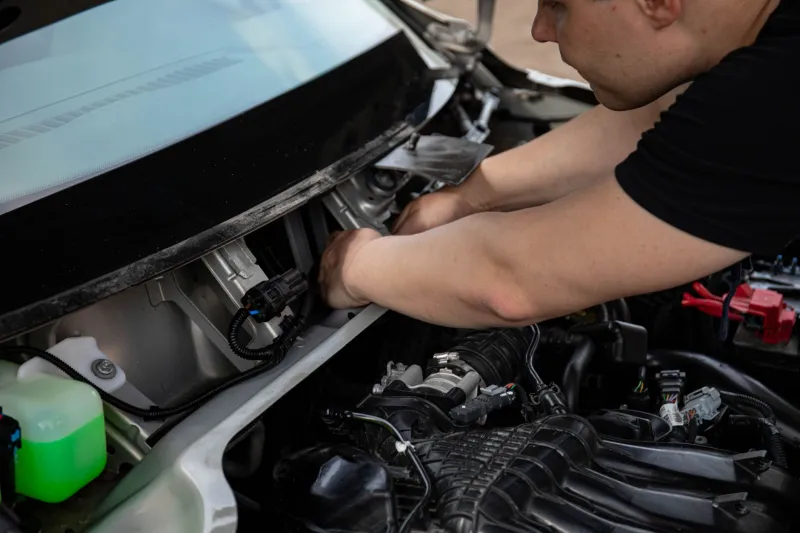
Once a Hyundai enters what might be called its post-loan phase, certain maintenance investments become especially important. Owners who understand these milestones are far better positioned to extend vehicle life without incurring unnecessary costs.
Timing belt or chain service. Depending on the model and engine configuration, timing components may require attention between 60,000 and 100,000 miles. Neglecting this service can result in catastrophic engine damage, while addressing it proactively is relatively affordable.
Transmission fluid and cooling system service. These are frequently overlooked in routine maintenance schedules but become critical as mileage accumulates. Fresh transmission fluid and a properly functioning cooling system are among the most effective ways to preserve drivetrain health.
Suspension and steering components. Bushings, ball joints, and struts experience significant wear over time, particularly in regions with rough roads or extreme temperature variation. Addressing these components not only extends vehicle life but also preserves the handling characteristics that make driving a Hyundai enjoyable.
Battery and electrical system evaluation. Modern Hyundai vehicles, particularly those equipped with advanced driver assistance systems and connected technology features, place consistent demands on the electrical system. A professional evaluation of the battery and charging system every few years is a modest investment that prevents inconvenient failures.
Owners who commit to this level of proactive care consistently report that the cost of maintenance remains dramatically lower than the cost of replacement — even when accounting for occasional larger repairs.
Real Owners, Real Calculations
Across Hyundai owner forums and community groups throughout the United States, the financial math of extended ownership comes up repeatedly. One owner in the Pacific Northwest described keeping a 2014 Sonata through 180,000 miles, calculating that the four years of payment-free driving following loan payoff had saved her more than $28,000 in financing costs alone — funds that went instead toward a home renovation and a fully funded emergency account.
Another owner in the Southeast shared that his 2016 Tucson, now approaching 140,000 miles, had required only routine maintenance and one minor repair in the two years since he made his final payment. His monthly transportation cost during that period was, by his own accounting, roughly $85 — a figure that includes insurance, fuel, and all maintenance expenses averaged across the year.
These stories are not exceptional. They represent a pattern that emerges when quality engineering meets disciplined ownership.
Deciding Whether to Keep Driving or Trade Up
Not every situation calls for indefinite retention. There are legitimate reasons to consider trading a paid-off Hyundai, and approaching that decision with clear criteria produces better outcomes than acting on impulse or marketing pressure.
Consider trading when repair estimates begin approaching or exceeding the vehicle's current market value, when the cumulative cost of deferred maintenance creates a financial burden that erodes the monthly savings of payment-free ownership, or when life circumstances — a growing family, a longer commute, or a new climate — genuinely require different vehicle capabilities.
Conversely, the case for continued ownership strengthens when the vehicle is mechanically sound, when its current capabilities match your daily needs, and when the financial benefit of avoiding new financing is meaningful to your broader financial picture. In today's market, where new vehicle prices remain elevated and financing rates have increased significantly from historic lows, the value of a reliable, debt-free Hyundai is higher than it has been in years.
If a trade does eventually make sense, a well-maintained Hyundai with a documented service history commands meaningfully stronger resale value than a comparable vehicle without those records. Every service receipt kept, every oil change logged, and every scheduled inspection completed contributes to a narrative that prospective buyers and dealerships recognize and reward.
The Shift in How Americans Think About Car Ownership
There is a broader cultural shift underway in how American drivers relate to their vehicles. For decades, the automotive industry and consumer culture alike reinforced a cycle of perpetual upgrade — new model, new loan, new payment. That cycle is beginning to give way to a more deliberate approach among a segment of owners who have discovered that reliability and financial discipline can coexist comfortably.
Hyundai owners, perhaps more than drivers of many other brands, find themselves at the center of this shift. The combination of competitive initial pricing, genuine mechanical durability, and a comprehensive ownership support structure has positioned Hyundai vehicles as particularly well-suited to long-term retention strategies.
At Hyundai Ngo Can 5S, we have spoken with owners at every stage of this journey — from the first payment to the final one and well beyond. The consistent thread in those conversations is surprise: surprise at how capable the vehicle remains, surprise at how much the financial benefit accumulates, and surprise at how little the decision to keep driving requires in the way of sacrifice.
The loan ends. The road does not.